
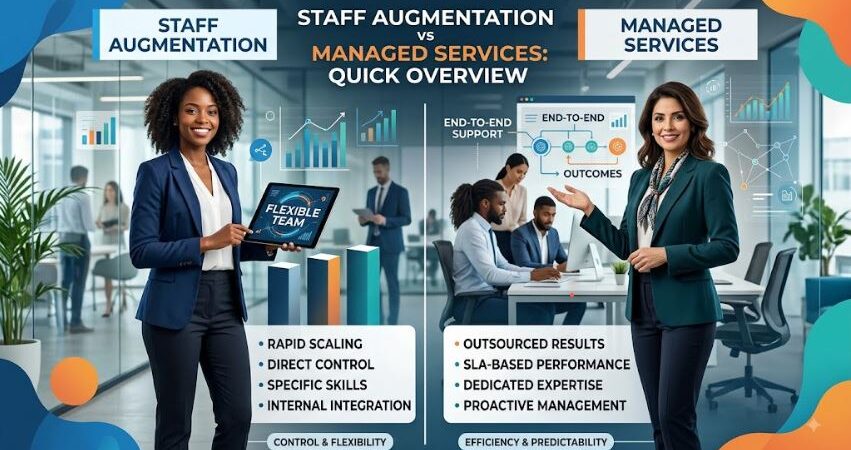
Staff Augmentation vs Managed Services and choosing between staff augmentation and managed services is one of the most critical decisions your company will make when scaling operations. The wrong choice can drain your budget, create management headaches, and slow down project delivery. The right choice can unlock flexibility, reduce costs, and let your team focus on what matters most.
The problem? Most business leaders don’t fully understand how these two outsourcing models differ. They hear “augmentation” and “managed services” and assume they’re basically the same thing. They’re not.
Staff augmentation brings external professionals into your existing team structure for Contract jobs and Fulltime roles also. Managed services, on the other hand, means handing off entire business functions to a specialized vendor. It’s the difference between adding players to your roster versus hiring a new coach to run the entire team.
Key Takeaways
- Staff augmentation gives you direct control and flexibility, while managed services transfers responsibility to the vendor
- Staff augmentation works best for short-term projects; managed services suits long-term, ongoing operations
- Managed services typically costs more upfront but offers predictable budgeting and reduced hiring headaches
- Staff augmentation requires strong internal management but gives you access to specialized skills on-demand
- The best choice depends on your project scope, timeline, internal capacity, and budget flexibility
What is Staff Augmentation?
Staff augmentation is a straightforward outsourcing model where you hire external professionals to work alongside your existing team. These augmented staff members integrate directly into your organization, report to your managers, and follow your processes and workflows.
Think of it as temporary team expansion. You’re not outsourcing entire functions—you’re adding skilled workers to fill specific gaps. If you need a Java developer for six months, a QA specialist for a sprint cycle, or a project coordinator to help with a surge in workload, staff augmentation delivers exactly that.
How Staff Augmentation Works
You identify a skill gap or capacity shortage within your team. You contact a staffing provider, specify your requirements, and they source candidates who match your needs. Once hired, these professionals integrate into your existing structure. You manage them directly, assign tasks, and hold them accountable to your internal standards.
The augmented staff member becomes part of your team for the duration of the engagement. They attend your meetings, use your tools, and operate under your management. When the project ends or the skill is no longer needed, the engagement concludes.
Key Characteristics of Staff Augmentation
- Direct Control: You maintain full management oversight and decision-making authority
- Flexibility: Easy to scale up or down based on project demands
- Cost Transparency: You pay for exactly the hours and resources you use
- Quick Onboarding: Faster implementation compared to building internal teams
- Skill Specificity: Access to specialized professionals without long-term commitment
- Cultural Integration: External hires work within your existing organizational structure
What is Managed Services?
Managed services represents a different outsourcing paradigm entirely. Instead of adding individual contributors to your team, you hand off entire business functions or processes to an external provider who assumes responsibility for delivering results.
With managed services, the vendor doesn’t just supply workers—they supply expertise, processes, accountability, and outcomes. You’re buying a service, not labor. The vendor manages staffing, quality control, performance metrics, and continuous improvement.
For example, instead of hiring IT staff to manage your network infrastructure, a managed IT services provider takes complete responsibility for keeping your systems running, secure, and updated. You pay a monthly fee and expect a specific service level, backed by an SLA (Service Level Agreement).
How Managed Services Works
You define business outcomes and service requirements with your provider. The vendor then assembles a team, implements processes, and delivers against those requirements. You don’t manage individual staff members—you manage the vendor through agreed-upon metrics and KPIs. If something breaks down, the vendor fixes it. If they miss targets, there are financial consequences.
Key Characteristics of Managed Services
- Outcome Accountability: Vendor is responsible for delivering specific results and maintaining SLA commitments
- Process Standardization: Vendor implements proven processes and best practices
- Vendor Management: You manage one vendor relationship instead of multiple team members
- Predictable Costs: Fixed monthly fees with minimal surprises
- Reduced Hiring Burden: No recruiting, interviewing, or onboarding responsibilities
- Scalability Through Infrastructure: Easily adjust service levels without hiring new staff
Staff Augmentation vs Managed Services: Side-by-Side Comparison
| Factor | Staff Augmentation | Managed Services |
|---|---|---|
| Control Level | You manage staff directly | Vendor manages resources and processes |
| Responsibility | Shared responsibility | Vendor bears full accountability |
| Cost Model | Pay-per-resource (hourly/monthly) | Fixed monthly fee or outcome-based |
| Best For | Short-term projects, specific skills | Ongoing operations, complete functions |
| Flexibility | Extremely high, easy to adjust | Moderate, governed by contract terms |
| Setup Time | Quick (days to weeks) | Longer (weeks to months) |
| Management Overhead | Higher (managing people) | Lower (managing vendor) |
| Scalability | Easy to add/remove people | Scales within vendor’s capacity |
| Predictability | Variable based on utilization | Highly predictable costs and outcomes |
| Risk | Higher management risk | Higher dependency on vendor quality |
Staff Augmentation: Advantages and Disadvantages
Advantages
Maximum Flexibility: Scale your team up or down based on immediate needs without long-term commitments. Need five developers for three months? You’ve got them. Need two? Easy adjustment.
Direct Control: You set priorities, manage timelines, and hold people directly accountable. There’s no middle layer between you and the work getting done.
Cost Efficiency for Short-Term Needs: Pay only for the resources you actually use, with no obligation to maintain service levels during slower periods.
Access to Specialized Skills: Tap into a global talent pool without the expense of hiring full-time employees with expensive benefits, training, and severance obligations.
Faster Time-to-Productivity: External professionals integrate quickly into your existing workflows since you’re not implementing new processes—they adapt to yours.
Disadvantages
Higher Management Burden: You need strong internal project and people management capabilities to effectively oversee augmented staff.
Quality Variability: Staff quality depends on your recruitment partner. A poor hire directly impacts your team productivity.
Knowledge Retention Issues: When augmented staff leave, specialized knowledge walks out the door. You’re responsible for documentation and knowledge transfer.
Integration Challenges: External team members may struggle with your company culture, processes, or communication norms, creating friction.
Hidden Costs: Onboarding time, management overhead, and knowledge transfer can add up beyond the stated resource cost.
Less Strategic Partnership: Vendors provide workers, not strategic guidance or process optimization recommendations.
Managed Services: Advantages and Disadvantages
Advantages
End-to-End Accountability: The vendor is responsible for delivering results. If something goes wrong, they fix it—no excuses.
Predictable Budgeting: Fixed monthly costs make financial forecasting straightforward. No surprises or unexpected overages.
Reduced Management Overhead: You manage the vendor relationship, not individual staff members. Less time spent on hiring, training, and performance management.
Process Optimization: Managed service providers bring industry best practices and proven methodologies. You benefit from their experience across multiple clients.
Scalability at Scale: Vendors have infrastructure and processes to handle growth smoothly without you managing hiring cycles.
Strategic Guidance: Good vendors don’t just execute—they advise on optimization, efficiency improvements, and technology investments.
Disadvantages
Higher Initial and Ongoing Costs: Managed services typically costs more than staff augmentation because you’re paying for accountability, processes, and infrastructure overhead.
Less Direct Control: You’re dependent on the vendor’s decision-making about staffing, methodologies, and resource allocation.
Longer Implementation Timeline: Setting up managed services takes weeks or months. You need thorough requirements gathering and vendor onboarding.
Vendor Lock-In Risk: Switching providers mid-contract is disruptive and expensive. You’re committed to the vendor relationship.
Quality Dependency: Your results depend entirely on vendor capabilities. A poor vendor relationship creates significant problems.
Loss of Visibility: You’re managing outcomes, not processes. Less visibility into how work is actually being done day-to-day.
When to Choose Staff Augmentation
Staff augmentation makes sense when:
You Have Specific, Temporary Skill Gaps: You need a data scientist for a three-month analytics project or a specialized developer for a particular technology stack.
Your Team Can Manage Additional Resources: You have strong project management capabilities and experienced team leads who can onboard and direct external professionals.
Project Scope is Clearly Defined: You know exactly what needs to be done and can articulate clear deliverables and expectations to external hires.
Budget Flexibility Matters More Than Predictability: You prefer paying only for resources you use rather than fixed monthly commitments.
Faster Implementation is Critical: You need to get started immediately and don’t have time for lengthy vendor onboarding.
Knowledge Retention is Important: You want the augmented professionals to learn your business, document processes, and strengthen your internal capabilities.
When to Choose Managed Services
Managed services makes sense when:
You Need Full-Function Outsourcing: You want to hand off complete business functions like IT infrastructure, HR administration, or accounting.
Long-Term, Ongoing Operations: Your need is permanent or multi-year, not temporary or project-based.
Predictability and Accountability Matter: You need fixed costs and guaranteed SLAs rather than variable resource costs.
Internal Capacity is Limited: Your management team is stretched too thin to oversee additional staff members.
You Want Strategic Partnership: You value vendor input on optimization, technology decisions, and operational efficiency.
Quality and Consistency are Critical: You need standardized processes and consistent delivery across an extended period.
Risk Mitigation is a Priority: You want to transfer operational and management risk to the vendor.
Expert Tips for Choosing the Right Model
Assess Your Internal Management Capacity: If your team is fully stretched managing current operations, managed services reduces overhead. If you have available management bandwidth, staff augmentation offers more flexibility.
Define Your Timeline Clearly: Short-term (under 12 months) typically favors augmentation. Long-term (2+ years) typically favors managed services.
Calculate True Total Cost: Don’t just compare hourly rates. Include management overhead, onboarding time, training costs, and knowledge transfer requirements.
Evaluate Vendor Track Record: If choosing managed services, thoroughly vet the vendor’s experience in your industry and their SLA compliance history.
Start Small: Consider a pilot engagement with either model before committing to a large-scale, long-term relationship.
Clarify Communication Expectations: Document how often you’ll communicate, what metrics you’ll track, and how decisions will be made.
Plan for Transition: Whether you choose augmentation or managed services, plan how you’ll handle transition if the engagement ends.
Common Mistakes to Avoid
Mistaking Staff Augmentation for Managed Services: Assuming you can hire individual contractors and expect them to autonomously deliver results without your management is unrealistic and sets everyone up for failure.
Choosing Based on Cost Alone: The cheapest option isn’t always the best value. Consider quality, management overhead, and risk transfer.
Insufficient Vendor Vetting: Spending time upfront to verify vendor capabilities saves significant problems later.
Poor Requirement Definition: Vague requirements lead to misaligned expectations. Spend time clearly defining what you need before engaging a provider.
Neglecting Communication Cadence: Whether augmentation or managed services, regular communication prevents misalignment.
Ignoring Cultural Fit: Team chemistry matters. Augmented staff who don’t align with your culture create friction.
Setting Unrealistic Timelines: Expecting immediate results from either model ignores necessary ramp-up time.
Benefits of Each Model
Staff Augmentation Benefits
- Access specialized skills without hiring permanent employees
- Scale team capacity up or down based on project demands
- Maintain direct control over work quality and priorities
- Reduce long-term employment costs and benefits obligations
- Quickly fill skill gaps that would take months to recruit internally
- Preserve company knowledge and institutional continuity
- Test potential future full-time hires before making permanent commitments
Managed Services Benefits
- Shift operational management responsibility to experienced providers
- Benefit from vendor expertise and industry best practices
- Achieve consistent service quality through SLAs and performance metrics
- Reduce internal hiring and HR administration burden
- Gain predictable, fixed-cost budgeting
- Access vendor’s technology infrastructure and tools
- Focus your team on strategic priorities rather than operational details
- Transfer risk and accountability to the vendor
FAQs
Can I use both staff augmentation and managed services simultaneously?
Yes, absolutely. Many organizations use staff augmentation for specific project needs while leveraging managed services for ongoing operational functions. For example, you might have a managed IT services provider handling infrastructure while using staff augmentation to hire contract developers for a new software initiative. The key is ensuring clear separation of responsibilities and avoiding overlap or confusion about who owns what.
What’s the typical cost difference between staff augmentation and managed services?
Staff augmentation typically costs less per resource hour, but managed services often provides better cost predictability. Augmentation might range from $30-150+ per hour depending on skill level, while managed services usually involves fixed monthly fees. However, augmentation’s hidden management costs can add 20-40% to the stated resource cost. Managed services has higher upfront costs but more stable long-term pricing.
How long does it take to transition from one model to the other?
Transitioning from staff augmentation to managed services typically takes 4-12 weeks depending on complexity. You’ll need to document processes, define SLAs, knowledge transfer, and establish new vendor relationships. Transitioning away from managed services can take longer if you’re bringing functions back in-house, potentially 3-6 months or more.
What happens to augmented staff when a project ends?
When a project ends, the augmented staff member’s engagement concludes. Some organizations convert successful augmented hires to full-time positions, but this isn’t automatic. Ensure your contract clearly specifies what happens post-engagement and whether the hire might be extended based on future needs.
How do I ensure quality with managed services if I have less direct control?
Managed services quality depends on two things: clearly defined SLAs with specific, measurable metrics, and regular vendor performance reviews. Include penalty clauses for missed SLAs, schedule monthly business reviews to assess performance, and maintain open communication about quality expectations and concerns.
Conclusion
The choice between staff augmentation and managed services isn’t about which model is objectively “better”—it’s about which model aligns with your specific business needs, timeline, and operational capabilities.
Staff augmentation excels when you need flexibility, have the internal management capacity, and face temporary skill gaps or project-based demands. It’s your pathway to rapid team expansion with minimal long-term commitment.
Managed services delivers value when you’re seeking predictable costs, end-to-end accountability, and want to transfer operational management responsibility to experienced vendors. It’s your pathway to outsourcing entire business functions and focusing your team on strategic priorities.
The best organizations recognize that this isn’t an either-or decision. They use both models strategically—augmentation for specific projects and skill gaps, managed services for ongoing operational functions. This hybrid approach provides flexibility where needed while maintaining predictability and accountability for core operations.
Start by honestly assessing your internal capacity, timeline requirements, and budget constraints. Then match those realities to the model that best serves your business. If you’re unsure, start with a pilot engagement to test the model before making larger, longer-term commitments.
The right outsourcing model isn’t the cheapest one—it’s the one that lets your core team focus on what makes your business unique while providing the external capacity and expertise you need to execute your strategy effectively.
2 thoughts on “Staff Augmentation vs Managed Services: Which Model is Right for Your Business”
Comments are closed.